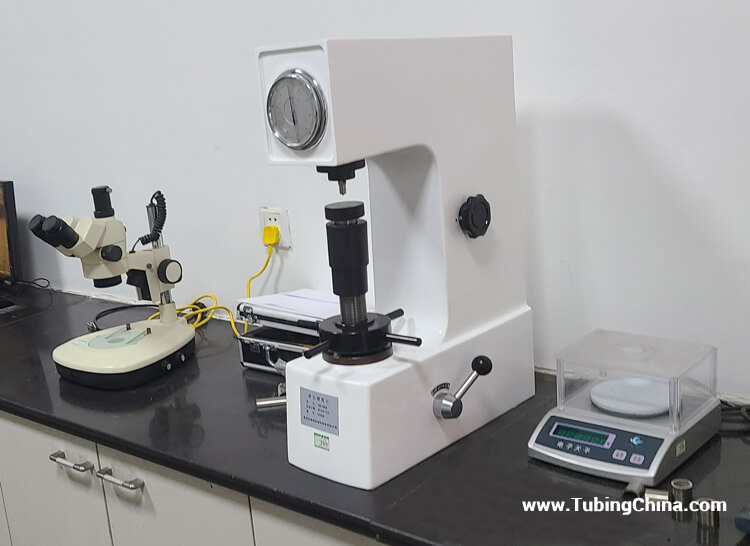
Definitions and Representation Methods for Brinell, Rockwell, Vickers, and Shore Hardness
Vickers Hardness (Vickers Hardness)
- Principle: A square-based diamond pyramid with a 136° angle between opposite faces is pressed into the material under a specific load for a defined dwell time. The load is removed, and the two diagonals of the resulting impression are measured using a microscope. The average diagonal length is used to calculate the Vickers hardness number (HV) via a formula or conversion table.
- Characteristics:
- Unified Scale: A key advantage is the continuous scale from very light loads (microhardness) to higher loads. HV values from different loads are theoretically comparable (e.g., HV10 can be related to HV0.1).
- Wide Application: The diamond indenter allows testing of very soft materials (e.g., aluminum) and extremely hard materials (e.g., nitrided layers, ceramics) simply by changing the load.
- High Accuracy: Measuring diagonal length is more precise than measuring indentation diameter or depth.
- Small Indentation: Considered a minimally destructive test, making it suitable for finished products and thin specimens.
- Disadvantage: The testing process is relatively slow, requires a skilled operator to measure diagonals, and is less efficient than Rockwell testing.
2. Brinell Hardness (Brinell Hardness)
- Principle: A specified diameter tungsten carbide ball (HBW; hardened steel ball, HBS, is obsolete) is forced into the material under a predetermined load. After the load is maintained for a specific time, it is removed. The diameter of the resulting indentation is measured. The Brinell hardness number (HBW) is then calculated from a formula or found via a table based on the load and the indentation diameter.
- Characteristics:
- Large Indentation: The high loads create a large surface area indentation. This provides an excellent average value of the material’s bulk properties and is particularly suitable for coarse-grained or heterogeneous materials like cast iron.
- Data Stability: The large indentation size minimizes the effect of local microstructural variations, leading to excellent repeatability and a result that reflects the material’s true macro-hardness.
- Highly Destructive: Not suitable for finished goods or very thin specimens due to the large, permanent impression.
- Limitation: Not suitable for very hard materials (typically >650 HBW), as the ball indenter itself can deform, compromising the result’s accuracy.
3. Rockwell Hardness (Rockwell Hardness)
- Principle: This method uses a two-stage loading process:
- A minor (pre) load (typically 10 kgf) is applied to seat the indenter and establish a reference position (zero point).
- A major (main) load is then applied and held for a set dwell time, forcing the indenter deeper.
- The major load is removed, while the minor load is maintained. The material recovers slightly from elastic deformation. The permanent increase in depth of penetration (*e*), from the initial pre-load reference point to the final position under the pre-load, is measured. This depth difference is converted to a Rockwell hardness number (e.g., HRC). A larger depth difference means a softer material (lower number).
- Characteristics:
- Rapid Operation: The hardness number is read directly from a dial or digital display immediately after the test. No optical measurement is needed, making it the fastest method, ideal for high-volume production quality control.
- Multiple Scales: By combining different indenters (diamond cone or balls of different sizes) and major loads, various scales (HRA, HRB, HRC, HR15N, HR30T, etc.) are created to cover a wide range of material hardnesses.
- Non-Unified Scales: This is the major drawback. The scales are arbitrary; a value of 60 on the HRA scale represents a completely different hardness than 60 on the HRC scale. They cannot be directly compared.
- Lower Relative Accuracy: Measuring depth is inherently less precise than measuring length (diagonals/diameter). Results are also more sensitive to surface finish and flatness.
4. Shore Hardness
The measurement principle of Shore hardness involves pressing a specific-shaped indenter into non-metallic specimens such as plastics, rubber, and glass under defined conditions to form an indentation depth, which is then converted into a hardness value.
Example notation: Shore A/15:70 indicates a Shore A tester used to indent the sample for 15 seconds, yielding a Shore A hardness value of 70.
Shore hardness applications: It employs four scales (indenters):
A indenter is suitable for general-purpose rubber, synthetic rubber, soft rubber, polyesters, leather, wax, etc.
D indenter: Suitable for high-hardness rubber, resins, acrylic, glass, thermoplastic rubber, printing plates, fibers, etc.
AO indenter: Suitable for low-hardness rubber, rubber-plastic blends, sponge.
AM indenter: Suitable for thin specimens of ordinary hardness.
Hardness | Hardness Testing | Hardness Test Methods | Brinell Hardness | Rockwell Hardness | Vickers Hardness | Superficial Rockwell Hardness | Shore Durometer Test | Hardness Conversion Table | Brinell Rockwell Hardness Conversion | Carbon Steel Cast Steel Hardness Conversion | Rockwell Superficial Brinell Vickers Shore Hardness Conversion | Harder Scales Equivalent | Softer Scales Equivalent | Figure Comparing Hardness Scales | Table of Components Showing Relevant Surface Hardness Values | O-Ring Installation Compressive Load vs Hardness Shore A Scale | Detect Hardness