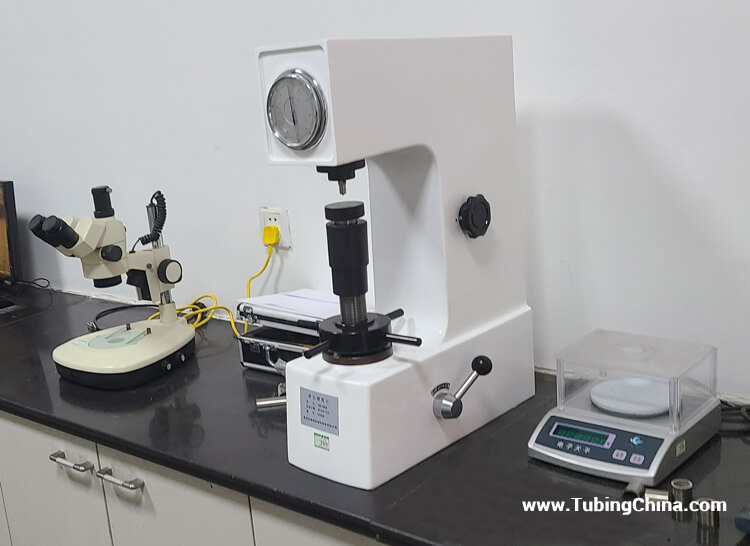
Minimum Thickness for HRB Testing of Stainless Steel Tubes per ASTM E18
According to ASTM E18, the minimum thickness requirement for Rockwell HRB testing of stainless steel tubes (or other metallic materials) is determined to prevent excessive deformation or anvil effects that could compromise hardness measurement accuracy.
1. General Rule for Minimum Thickness
- 10× Indentation Depth Criterion:
The specimen thickness must be at least 10 times the indentation depth to avoid backside deformation.- For HRB (using a 1.588 mm steel ball indenter under 100 kgf load), typical indentation depths range from 0.08–0.12 mm (depending on material hardness).
- Thus, the minimum recommended thickness is 1.0–1.5 mm.
- Practical Industry Practice:
For stainless steel tubes, a safe minimum thickness is ≥ 1.5 mm to ensure reliable HRB readings, especially for softer grades (e.g., annealed austenitic stainless steels).
2. Key Considerations
- Backside Deformation: If the tube wall is too thin, the test force may cause bulging on the reverse side, leading to falsely elevated hardness values.
- Verification: ASTM E18 recommends inspecting the specimen post-test to confirm no visible backside deformation occurred.
- Alternatives for Thin Tubes:
If the wall thickness is below 1.5 mm, consider:- Superficial Rockwell scales (e.g., HR15T for thin sheets/tubes).
- Microhardness testing (HV) for localized measurements.
3. Comparison with HRC Testing
While HRC (diamond cone, 150 kgf) requires ≥ 1.0 mm minimum thickness due to shallower indentation, HRB’s larger steel ball indenter necessitates greater material thickness for equivalent reliability.
Conclusion
For HRB testing of stainless steel tubes per ASTM E18, the minimum thickness should be ≥ 1.5 mm to ensure accurate and repeatable results. Always validate with actual material hardness and testing conditions.
Hardness | Hardness Testing | Hardness Test Methods | Brinell Hardness | Rockwell Hardness | Vickers Hardness | Superficial Rockwell Hardness | Shore Durometer Test | Hardness Conversion Table | Brinell Rockwell Hardness Conversion | Carbon Steel Cast Steel Hardness Conversion | Rockwell Superficial Brinell Vickers Shore Hardness Conversion | Harder Scales Equivalent | Softer Scales Equivalent | Figure Comparing Hardness Scales | Table of Components Showing Relevant Surface Hardness Values | O-Ring Installation Compressive Load vs Hardness Shore A Scale | Detect The Hardness Of Stainless Steel