
Procedure of ASTM A262 Practice E Intergranular Corrosion
According to ASTM A262, Intergranular Corrosion Test Pratice E procedure as below.
1. Test Principle
This practice is used to detect the presence of chromium-depleted zones (susceptibility to intergranular corrosion) in austenitic stainless steel by exposing a specimen to a boiling, acidic copper sulfate-sulfuric acid solution. The copper acts as a cathodic reactant, accelerating the attack on susceptible grain boundaries.
2. Key Apparatus & Reagents
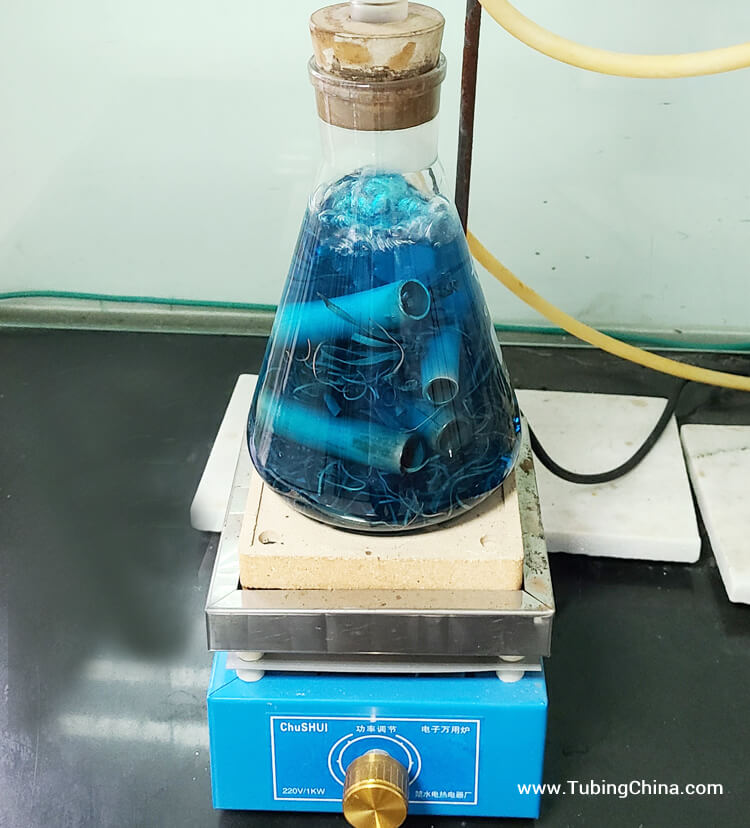
- Test Vessel: A glass flask fitted with a water-cooled condenser for reflux.
- Solution: Prepared with reagent-grade chemicals – 100 g of CuSO₄·5H₂O dissolved in 1 L of dilute sulfuric acid (100 mL of H₂SO₄ + 900 mL of distilled water).
- Metallic Copper: Copper shots or turnings are placed at the bottom of the flask.
- Heating Source: A hot plate or heating mantle to maintain boiling.
- Bending Fixture: A jig or vise for performing the post-exposure bend test.
3. Specimen Preparation
- A representative sample (often a saw-cut coupon) is taken from the material.
- The specimen surface (including edges) must be clean and free of contaminants. It is typically degreased and may be lightly ground or pickled to remove scale.
- The specimen dimensions are measured and recorded.
4. Test Procedure
- The copper metal is placed at the bottom of the flask.
- The prepared test solution is added to the flask.
- The specimen is fully immersed in the solution, ensuring it does not contact the copper metal directly (often suspended by a glass hook or placed on a glass cradle).
- The condenser is attached, and the solution is brought to a vigorous boil.
- The test duration is 24 hours for most materials (15 hours for low-carbon or stabilized grades like 304L Stainless Steel or 321 Stainless Steel, as specified).
- After the exposure period, the specimen is removed, rinsed, dried, and may be lightly brushed to remove corrosion products.
5. Evaluation & Interpretation
- The key evaluation is a bend test. The specimen is bent approximately 180 degrees over a mandrel (diameter specified based on specimen thickness).
- The bent surface is then examined visually (often with the aid of a low-power magnifier, up to 20x).
- Acceptance Criterion: The presence of cracks on the bent surface indicates a FAIL. These cracks result from the opening of severely corroded grain boundaries. The absence of cracks indicates a PASS.
- Important: Surface steps or wrinkles from normal bending are not failures. Only distinct cracks are considered evidence of intergranular attack.
6. Reporting
The report must include material identification, specimen dimensions, test duration, a description of the bent surface (noting presence/absence of cracks), and the final assessment (pass/fail). Any deviation from the standard practice must be noted.
Metallographic Test – Metallography Testing
Metallographic Test Report
Stress Corrosion Cracking (SCC)
Chloride Stress Corrosion Cracking
Stainless Steel Corrosion
Corrosion of Piping
Corrosion Process
Surface Coatings for Corrosion
Corrosion Resistant Material
Bi- Metallic Corrosion.Galvanic Corrosion
Intergranular Corrosion
Intergranular Corrosion of Stainless Steel Tubes
Corrosion Resistant Stainless Steel Tube
Corrosion Resistance of Stainless Steel Tubes
Seawater Resistance of Stainless Steel Tubes
Corrosion Mechanism in Stainless Steel Tube
ASTM A262 Intergranular Corrosion Test IGC
ASTM E112 Standard Test Methods for Determining Average Grain Size
Methods of minimizing chloride stress corrosion cracking