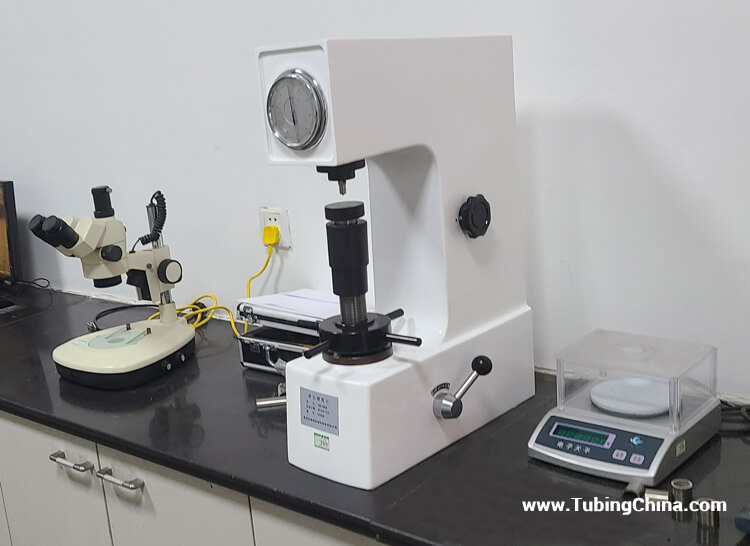
How to Choose Rockwell Hardness HRC Brinell Hardness HBW Rockwell B Scale HRB Vickers Hardness HV?
- Need to quickly check the hardness of many heat-treated steel parts? -> Rockwell Hardness (HRC). The king of speed.
- Need to measure the hardness of soft materials like aluminum or mild steel? -> Brinell Hardness (HBW) or Rockwell B Scale (HRB). Brinell is better for average properties; Rockwell is faster.
- Need to measure surface hardening layers, platings, thin sheets, or very small components? -> Vickers Hardness (HV). The only choice for low-load, high-precision testing.
- Need to measure extremely hard materials like ceramics or glass? -> Vickers Hardness (HV). The diamond indenter can handle it.
- Need the best measure of a material’s overall, average bulk hardness? -> Brinell Hardness (HBW). The large indentation provides the best representation.
- Brinell Hardness: Suitable for lower-hardness metallic materials such as annealed, normalized, quenched and tempered steels, cast iron, and non-ferrous metals.
- Rockwell Hardness: Most commonly used in industrial production, suitable for higher-hardness metallic materials such as quenched steels and quenched and tempered steels.
- Vickers Hardness: Causes minimal damage to workpieces due to low applied pressure and shallow indentation depth during testing. Particularly suitable for measuring surface-hardened layers and chemically treated surfaces, offering greater precision than Brinell or Rockwell hardness. However, the testing procedure is relatively cumbersome, making it rarely used in production settings. It is primarily employed in laboratories and research applications.
- Shore Hardness: Primarily used to determine the hardness of non-metallic components such as rubber, plastics, and glass
Brinell, Rockwell, and Vickers hardness scales are primarily designed for metallic materials and are closely related, functioning like three brothers that can be converted between each other. For example, for the same material: 285 HBW corresponds to 29.8 HRC and 300 HV. For detailed information, refer to ASTM E140. Shore hardness has a less direct relationship with these three scales.
When material properties are specified in engineering drawings, technical requirements typically use simplified hardness notations: 350 HBW, 60 HRC, 640 HV, Shore 80, etc., rather than full descriptions.
Differences and Conversion Between Rockwell Hardness Scales HRA, HRB, and HRC Rockwell hardness (HR) testing is employed when the specimen is too small or when Brinell hardness (HB) exceeds 450.
The test method involves pressing a diamond cone with a 120-degree apex or a steel ball with a diameter of 1.59mm/3.18mm into the material surface under a specified load. The material’s hardness is determined by the depth of the indentation.
Depending on the material’s hardness, three distinct scales are used: HRA: Hardness measured using a 60 kg load and a diamond cone indenter, applied to extremely hard materials such as cemented carbide.
HRB is measured using a 100 kg load and a 1.58 mm diameter hardened steel ball, suitable for softer materials such as annealed steel and cast iron.
HRC is the hardness obtained using a 150 kg load and a diamond cone indenter, applied to very hard materials such as quenched steel.
In Rockwell hardness, the letters A, B, and C in HRA, HRB, and HRC denote three different standards, referred to as Scale A, Scale B, and Scale C.
The Rockwell hardness test is one of several commonly used indentation hardness tests today. All three scales share an initial pressure of 98.07N (10Kgf), with hardness values calculated based on the resulting indentation depth.
Scale A employs a ball-pyramid indenter, applying a pressure of 588.4N (60Kgf).
Scale B employs a steel ball indenter with a diameter of 1.588 mm (1/16 inch), applying a load of 980.7 N (100 kgf). Consequently, Scale B is suitable for testing softer materials. Scale C is designed for testing harder materials.
The most commonly used scales are HRC, HRB, and HRA. The HRC scale is used for testing quenched steel, tempered steel, quenched and tempered steel, and certain stainless steels. This is the most widely applied hardness testing method in the metalworking industry.
The HRB scale is used for testing various annealed steels, normalized steels, mild steels, certain stainless steels, and harder copper alloys. The HRA scale is used for testing pure copper, softer copper alloys, and hard aluminum alloys.
Although the HRA scale can also be used for most ferrous metals, its practical application is generally limited to testing cemented carbides and thin hard steel strip materials.
The HRA scale ranges from 20 to 88 HRA.
The following conversion relationships can be obtained from the American standard ASTM E140:
27HRA≈30HRB 60HRA≈100HRB≈20HRC 85.6HRA≈68HRC,
Conversion relationships from ASTM E140: 27HRA≈30HRB 60HRA≈100HRB≈20HRC 85.6HRA≈68HRC
Hardness | Hardness Testing | Hardness Test Methods | Brinell Hardness | Rockwell Hardness | Vickers Hardness | Superficial Rockwell Hardness | Shore Durometer Test | Hardness Conversion Table | Brinell Rockwell Hardness Conversion | Carbon Steel Cast Steel Hardness Conversion | Rockwell Superficial Brinell Vickers Shore Hardness Conversion | Harder Scales Equivalent | Softer Scales Equivalent | Figure Comparing Hardness Scales | Table of Components Showing Relevant Surface Hardness Values | O-Ring Installation Compressive Load vs Hardness Shore A Scale | Detect Hardness