
2507 Tubes ASTM A789 S32750 Tubes ASME SA789 S32750 Duplex Tubes

Guanyu Tube is specialized manufacturer of ASTM A789 S32750 Tubes, 2507 Super Duplex Tubing and 2507 Super Duplex Tube, 2507 Tubes, 2507 Seamless Tubes.
- 2507 Super Duplex Tubes Properties and Character
- 2507 Super Duplex Tubing Sizes
- ASME SA789 S32750 Chemical Composition
- 2507 Super Duplex Tube Mechanical Properties
- 2507 Super Duplex Tube Standard Specifications
- Duplex Stainless Steel Comparison Chart
- 2507 Tubes Benefits
- 2507 Super Duplex Tube and Pipes Applications
- 2507 Super Duplex Tube Marking and Packing
- 2507 Super Duplex Tube Exported Countries
- 2507 Super Duplex Tube Related Links
1.1 A789 S32750 Chemical Composition
S32750 features a carefully optimized composition to achieve a balanced 50/50 austeno-ferritic microstructure with outstanding corrosion resistance :
2507 Tubes EN 10216-5 1.4507 Chemical Composition
ASTM A789 S32750 SAF 2507 Pipe Chemical Composition
| C % | Si % | Mn % | P % | S % | Cr % | Ni % | Mo % | N % | Cu % |
| 0.03 max | 0.8 max | 1.2 max | 0.035 max | 0.02 max | 24.0-26.0 | 6.0-8.0 | 3.0-5.0 | 0.24-0.32 | 0.50 max |
EN 10216-5 1.4410 1.4507 Chemical Composition
| Grade | C % | Si % | Mn % | P % | S % | Cr % | Ni % | Mo % | N % | Cu % |
| 1.4507 | 0.030 max | 0.70 max | 2.00 max | 0.035 max | 0.015 max | 24.0-26.0 | 5.50-7.50 | 2.70-4.00 | 0.15-0.30 | 1.00-2.50 |
| 1.4410 | 0.030 max | 1.00 max | 2.00 max | 0.035 max | 0.015 max | 24.0-26.0 | 6.00- 8.00 | 3.00-4.5 | 0.20-0.35 |
The high chromium, molybdenum, and nitrogen content distinguishes S32750 from standard duplex grades like S32205 .
1.2 A789 S32750 Mechanical Properties
| Property | ASTM Minimum | Typical Value |
|---|---|---|
| Tensile Strength | 800 MPa (116 ksi) | 800 – 900+ MPa |
| Yield Strength (0.2% offset) | 550 MPa (80 ksi) | 550 – 600 MPa |
| Elongation | 15% – 25% (depending on specification) | ~25% |
| Hardness | 310 HB max (32 HRC max) | ~28 HRC |
| Impact Toughness | 40 J @ -50°C | ≥ 40 J |
Key mechanical features:
- Yield strength is approximately 3 times that of 316L stainless steel
- Cannot be hardened by heat treatment but can be strengthened by cold working
- Excellent notch ductility down to -50°C
1.3 Physical Properties
| Property | Value |
|---|---|
| Density | 7.85 g/cm³ (0.284 lb/in³) |
| Modulus of Elasticity | 190 – 200 GPa |
| Thermal Conductivity | Higher than austenitic steels |
| Coefficient of Thermal Expansion | Lower than austenitic steels |
1.4 Pitting Resistance Equivalent Number (PREN)
The PREN value is the critical indicator of a stainless steel’s resistance to pitting and crevice corrosion in chloride-containing environments.
PREN Formula: PREN = %Cr + 3.3 × %Mo + 16 × %N
| Grade | PREN Value |
|---|---|
| S32750 (Super Duplex) | >40 (minimum 41) |
| S32205 (Standard Duplex) | >35 |
| 316L (Austenitic) | ~24-25 |
The high PREN value of >41 provides pitting and crevice corrosion resistance superior to austenitic and standard duplex stainless steels in almost all corrosive media .
1.5 Temperature Limitations
⚠️ Important: Like other duplex stainless steels, S32750 is susceptible to embrittlement if used for prolonged periods at elevated temperatures . The material should not be used above 300°C for extended periods, as precipitation of brittle intermetallic phases can occur.
1.6 Microstructure
The super duplex microstructure consists of approximately equal proportions of austenite and ferrite. This balanced structure provides:
- High resistance to stress corrosion cracking (SCC)
- Superior mechanical strength properties
- Good weldability (no post-weld heat treatment required for many applications)
2. Advantages
2.1 Superior Corrosion Resistance
2.2 Exceptional Mechanical Strength
- Minimum yield strength of 550 MPa – approximately 3× higher than 316L and 1.2× higher than S32205
- Allows for significant wall thickness reduction (up to 50% compared to austenitic grades)
- Enables leaner, lighter designs for load-bearing applications
- Provides substantial weight and cost savings in offshore and subsea installations
2.3 Low Thermal Expansion and High Thermal Conductivity
- Exhibits a lower coefficient of thermal expansion than austenitic steels
- Higher heat conductivity than austenitic grades
- These properties reduce thermal stress issues in heat exchanger applications
2.4 Good Weldability and Workability
- Can be successfully welded with standard procedures
- Heat treatment after welding is not required for many applications
- Good workability allows for cold working and forming
- Available in both seamless and welded forms
2.5 ASME and NACE Approvals
- ASME Approval for Pressure Vessel applications
- NACE MR0175 approval for sour service (oil and gas applications with H₂S)
- Meets international standards including EN 10216-5
2.6 Cost-Effective Alternative to Nickel Alloys
- Often replaces more expensive nickel-based superalloys (e.g., Alloy 625, C-276) in moderately aggressive environments
- Provides cost-efficient alternatives for a wide range of demanding applications
- Lower life-cycle cost due to extended service life and reduced maintenance
3. Applications
3.1 Primary Industries and Applications
3.2 Specific Component Applications under ASTM A789
ASTM A789 covers seamless and welded tubes for:
- Heat exchanger tubes (seamless and welded)
- Condenser tubes
- Umbilical tubing for subsea oil and gas production
- General corrosive service tubing requiring high strength and corrosion resistance
3.3 Dimensional Availability
4. Comparison: S32750 (Super Duplex) vs. S32205 (Standard Duplex) vs. 316L
| Property | S32750 (Super Duplex) | S32205 (Standard Duplex) | 316L (Austenitic) |
|---|---|---|---|
| Cr content | 24-26% | 22-23% | 16-18% |
| Mo content | 3.0-5.0% | 3.0-3.5% | 2.0-3.0% |
| N content | 0.24-0.32% | 0.14-0.20% | 0.10 max |
| PREN | >41 | >35 | ~24-25 |
| Yield Strength (min) | 550 MPa | 450 MPa | ~170 MPa |
| Tensile Strength (min) | 800 MPa | 655 MPa | ~485 MPa |
| Elongation (min) | 15-25% | 25% | 35% |
| SCC resistance | Excellent | Very Good | Poor (>60°C) |
| Critical Pitting Temp | >50°C | ~40-45°C | ~20-25°C |
| Max service temp | 280-300°C | 300°C | >500°C |
| Relative cost | Highest | Moderate | Lowest |
| Typical applications | Subsea, desalination, FGD | Offshore topside, chemical | General purpose |
5. Important Limitations and Considerations
- Temperature restrictions: Do not use above 300°C (572°F) for extended periods due to embrittlement risk
- Low temperature limit: Maintains good properties down to -50°C (-58°F); avoid below this range
- Embrittlement risk: Prolonged exposure to 300-1000°C range causes precipitation of brittle intermetallic phases (sigma phase)
- Requires proper heat treatment: Solution annealing at 1020-1100°C followed by rapid cooling (water quench)
- Fabrication considerations: Higher strength requires more powerful forming equipment; welding requires proper filler metal selection and heat input control
- Not a replacement for nickel alloys in all cases: While cost-effective, extremely aggressive environments (e.g., high-temperature concentrated acids) may still require nickel superalloys
Summary
ASTM A789 S32750 super duplex stainless steel tubing represents the highest performance tier in the duplex stainless steel family. With a PREN value exceeding 41 and minimum yield strength of 550 MPa (approximately 3× that of 316L), it offers an exceptional combination of corrosion resistance and mechanical properties .
The material excels in the most demanding environments, particularly those involving:
- High chloride concentrations (seawater, brackish water, brines)
- Elevated temperatures (up to 280-300°C)
- Sour service (H₂S-containing environments)
- High mechanical loads requiring weight reduction
Key applications include subsea oil and gas umbilicals, high-pressure desalination plants, marine engineering, FGD systems, and chemical processing equipment where standard austenitic or duplex grades would fail prematurely . While it has temperature limitations and requires proper fabrication practices, S32750 is the material of choice for the most demanding corrosive service applications where life-cycle cost and reliability are paramount.
2507 Tubes Sizes
Outside Diameter: 6 – 530mm, Wall Thickness: 0.5 – 60mm. Length: 25000mm Maximum
ASTM A789 Duplex Steel Chemical Composition
The steel shall conform to the chemical requirements prescribed in Table 1.
| Designation | C | Mn | P | S | Si | Ni | Cr | Mo | N | Cu | Others |
| S31200 | 0.030 | 2.00 | 0.045 | 0.030 | 1.00 | 5.5–6.5 | 24.0–26.0 | 1.20–2.00 | 0.14–0.20 | . . . | . . . |
| S31260 | 0.030 | 1.00 | 0.030 | 0.030 | 0.75 | 5.5–7.5 | 24.0–26.0 | 2.5–3.5 | 0.10–0.30 | 0.20 –0.80 | W 0.10 –0.50 |
| S31500 | 0.030 | 1.20 –2.00 | 0.030 | 0.030 | 1.40 –2.00 | 4.3–5.2 | 18.0–19.0 | 2.50–3.00 | 0.05–0.1 | . . . | . . . |
| S31803 | 0.030 | 2.00 | 0.030 | 0.020 | 1.00 | 4.5–6.5 | 21.0–23.0 | 2.5–3.5 | 0.08–0.20 | . . . | . . . |
| S32001 | 0.030 | 4.00 –6.00 | 0.040 | 0.030 | 1.00 | 1.0–3.0 | 19.5–21.5 | 0.60 | 0.05–0.17 | 1.00 | . . . |
| S32003 | 0.030 | 2.00 | 0.030 | 0.020 | 1.00 | 3.0-4.0 | 19.5-22.5 | 1.50-2.00 | 0.14-0.20 | . . . | . . . |
| S32101 | 0.040 | 4.0-6.0 | 0.040 | 0.030 | 1.00 | 1.35-1.70 | 21.0-22.0 | 0.10-0.80 | 0.20-0.25 | 0.10 -0.80 | . . . |
| S32202 | 0.030 | 2.00 | 0.040 | 0.010 | 1.00 | 1.00–2.80 | 21.5–24.0 | 0.45 | 0.18–0.26 | . . . | . . . |
| S32205 | 0.030 | 2.00 | 0.030 | 0.020 | 1.00 | 4.5–6.5 | 22.0–23.0 | 3.0–3.5 | 0.14–0.20 | . . . | . . . |
| S32304 | 0.030 | 2.50 | 0.040 | 0.040 | 1.00 | 3.0–5.5 | 21.5–24.5 | 0.05–0.60 | 0.05–0.20 | 0.05 –0.60 | . . . |
| S32506 | 0.030 | 1.00 | 0.040 | 0.015 | 0.90 | 5.5–7.2 | 24.0–26.0 | 3.0–3.5 | 0.08–0.20 | . . . | W 0.05 –0.30 |
| S32520 | 0.030 | 1.50 | 0.035 | 0.020 | 0.80 | 5.5–8.0 | 23.0–25.0 | 3.–5. | 0.20–0.35 | 0.50 –3.00 | . . . |
| S32550 | 0.04 | 1.50 | 0.040 | 0.030 | 1.00 | 4.5–6.5 | 24.0–27.0 | 2.9–3.9 | 0.10–0.25 | 1.50 –2.50 | . . . |
| S32707 | 0.030 | 1.50 | 0.035 | 0.010 | 0.50 | 5.5–9.5 | 26.0–29.0 | 4.0–5.0 | 0.30–0.50 | 1.0 max | Co 0.5 –2.0 |
| S32750 | 0.030 | 1.20 | 0.035 | 0.020 | 0.80 | 6.0–8.0 | 24.0–26.0 | 3.0–5.0 | 0.24–0.32 | 0.50 | . . . |
| S32760 | 0.030 | 1.00 | 0.030 | 0.010 | 1.00 | 6.0–8.0 | 24.0–26.0 | 3.0–4.0 | 0.20–0.30 | 0.50 –1.00 | W 0.50 –1.00 |
| S32808 | 0.030 | 1.10 | 0.030 | 0.010 | 0.50 | 7.0–8.2 | 27.0–27.9 | 0.80–1.20 | 0.30–0.40 | . . . | W 2.10 –2.50 |
| S32900 | 0.08 | 1.00 | 0.040 | 0.030 | 0.75 | 2.5–5.0 | 23.0–28.0 | 1.00–2.00 | . . . | . . . | . . . |
| S32906 | 0.030 | 0.80 –1.50 | 0.030 | 0.030 | 0.80 | 5.8–7.5 | 28.0 –30.0 | 1.50–2.60 | 0.30–0.40 | 0.80 | . . . |
| S32950 | 0.030 | 2.00 | 0.035 | 0.010 | 0.60 | 3.5–5.2 | 26.0–29.0 | 1.00–2.50 | 0.15–0.35 | . . . | . . . |
| S33207 | 0.030 | 1.50 | 0.035 | 0.010 | 0.80 | 6.0–9.0 | 29.0–33.0 | 3.0–5.0 | 0.40–0.60 | 1.0 | . . . |
| S39274 | 0.030 | 1.00 | 0.030 | 0.020 | 0.80 | 6.0–8.0 | 24.0–26.0 | 2.5–3.5 | 0.24–0.32 | 0.20 –0.80 | W 1.50 –2.50 |
| S39277 | 0.025 | 0.80 | 0.025 | 0.002 | 0.80 | 6.5–8.0 | 24.0–26.0 | 3.00–4.00 | 0.23–0.33 | 1.20 –2.00 | W 0.80 –1.21 |
| S82011 | 0.030 | 2.0 –3.0 | 0.040 | 0.020 | 1.00 | 1.00–2.00 | 20.5–23.5 | 0.10–1.00 | 0.15–0.27 | 0.50 | . . . |
| S82441 | 0.030 | 2.50 –4.00 | 0.035 | 0.005 | 0.70 | 3.0–4.5 | 23.0–25.0 | 1.00–2.00 | 0.20–0.30 | 0.10 –0.80 |
A Maximum, unless a range or minimum is indicated. Where ellipses (…) appear in this table, there is no minimum and analysis for the element need not be determined or reported.
B Designation established in accordance with Practice E527 and SAE J1086 PREN
C % Cr + 3.3 × % Mo + 16 × % N $ 41.
D % Cr + 3.3 × % Mo + 16 × % N $ 40.
2507 Density Density of 2507 Tube
7810kg/m3, Weight calculation coefficient: 0.02450
2507 Tubes Mechanical Properties
ASTM A789 S32750SAF 2507 Pipe Mechanical Properties
| Tensile Strength, Mpa | Yield Strength, MPa | Elongation, % | Hardness, HB |
| 800 min | 550 min | 15 min | 310 max |
Tensile Strength and Hardness Requirements
11.1 The material shall conform to the tensile and hardness properties prescribed in Table 4.
| Grade | Tensile strength, min., ksi [MPa] | Yield strength, min., ksi [MPa] | Elongation in 2 in., or 50mm, min, % | Hardness, Max Brinell |
| S31803 | 90 [620] | 65 [450] | 25 | 290 |
| S32205 | 95 [655] | 70 [485] | 25 | 290 |
| S31500 | 92 [630] | 64 [440] | 30 | 290 |
| S32550 | 110 [760] | 80 [550] | 15 | 297 |
| S31200 | 100 [690] | 65 [450] | 25 | 280 |
| S31260 | 100 [690] | 65 [450] | 25 | 290 |
| S32001 | 90 [620] | 65 [450] | 25 | 290 |
| S32304 | 100 [690] | 65 [450] | 25 | 290 |
| S32750 | 116 [800] | 80 [550] | 15 | 310 |
| S32760 | 109 [750] | 80 [550] | 25 | 300 |
| S32950 | 100 [690] | 70 [480] | 20 | 290 |
| S32520 | 112 [770] | 80 [550] | 25 | 310 |
For tubing smaller than 1⁄2 in. [12.7 mm] in outside diameter, the elongation values given for strip specimens in Table 4 shall apply. Mechanical property requirements do not apply to tubing smaller than 1⁄8 in. [3.2 mm] in outside diameter or with walls thinner than 0.015 in. [0.4 mm].
Prior to A789/A789M–04, the values for S32003 were 90 ksi tensile strength and 65 ksi yield strength.
2507 Tubes 2507 Super Duplex Tube Standard Specifications
S32750 Stainless Steel Standard Specification:
| Standard | ASTM A789, ASME SA789, ASTM A790, ASME SA790 |
| Equivalent Standards | DIN 17458, GOST 9941-81, GOST 9940-81, EN 10216-5, ASTM A790, ASME SA790, DIN 17456 |
| Material | S32750 2507 Pipe |
| Equivalent Materials | X2CrNiMoN25-7-4, 1.4410, SAF 2507, F53 |
| Related Products | stainless steel tube, stainless steel pipe, heat exchanger tube, ASTM A789 |
Duplex Stainless Steel Comparison Chart
| China GB | ISO Unified Digital Code | ASTM / ASME | UNS code | EN Code | Company Commercial Grade |
| 022Cr23Ni4MoCuN | S23043 | S32304 | S32304 | 1.4362 | SAF2304 (Sandvik) |
| 022Cr22Ni5Mo3N | S22253 | S31803 | S31803 | 1.4462 | – |
| 022Cr23Ni5Mo3N | S22053 | S32205 | S32205 | 1.4462 | SAF2205 (Sandvik) |
| 022Cr25Ni7Mo4N | S25073 | S32750 | S32750 | 1.441 | SAF2507(Sandvik) |
| 022Cr25Ni7Mo3WCuN | S22583 | S31260 | S31260 | – | – |
| 03Cr25Ni6Mo3Cu2N | S25554 | S32550 | S32550 | 1.4507 | UR52+ |
| 022Cr25Ni7Mo4WCuN | S27603 | S32760 | S32760 | 1.4501 | Zeron100 |
| 00Cr27Ni7Mo5N | – | S32707 | S32707 | – | SAF2707(Sandvik) |
2507 Super Duplex Tubes Benefits
- High strength,
- High resistance to pitting, crevice corrosion resistance.
- High resistance to stress corrosion cracking, corrosion fatigue and erosion,
- Excellent resistance to CSCC chloride stress-corrosion cracking
- High thermal conductivity
- Low coefficient of thermal expansion
- Good sulfide stress corrosion resistance,
- Low thermal expansion and higher heat conductivity than austenitic steels,
- Good workability and weldability,
- High energy absorption.
2507 Tubes and Pipes Applications
Super Duplex Tubing are mainly used in seawater environment, petrochemical industry, chemical fertilizer industry, petroleum refining industry, petroleum and gas industry, light industry, pulp industry, energy and environment protection industry.
- Heat exchanger tubes and pipes for production and handling of gas and oil,
- Heat exchanger and pipes in desalination plants,
- Mechanical and structural components,
- Power industry FGD systems,
- Pipes in process industries handling solutions containing chlorides,
- Utility and industrial systems, rotors, fans, shafts and press rolls where the high corrosion fatigue strength can be utilized,
- Cargo tanks, vessels, piping and welding consumables for chemical tankers.
- High-strength, highly resistant wiring.
The various Alloys Super-Duplex falls under the Duplex stainless steel grouping. Duplex stainless steel are graded for their corrosion performance depending on their alloy content. Today, modern Duplex stainless steel can be divided into four groups:
- Lean Duplex such as 2304, which contains no deliberate Mo addition;
- 2205, the work-horse grade accounting for more than 80% of duplex usage;
- 25 Cr duplex such as Alloy 255 and DP-3;
- Super-Duplex; with 25-26 Cr and increased Mo and N compared with 25 Cr grades, including grades such as 2507, Zeron 100, UR 52N+, and DP-3W
Composition of Duplex Stainless Steel The table lists the Super Duplex Pipe covered in ASTM specifications for plate, sheet, and bar products.
a Weight percent, maximum unless otherwise noted.
b Unless otherwise indicated, a common name, not a trademark, widely used, not associated with any one producer, as listed in ASTM A 240.
c W 0.50-1.00; Cr+3.3Mo+16N=40 min.
d AISI designation
2507 Super Duplex Tube Marking and Packing
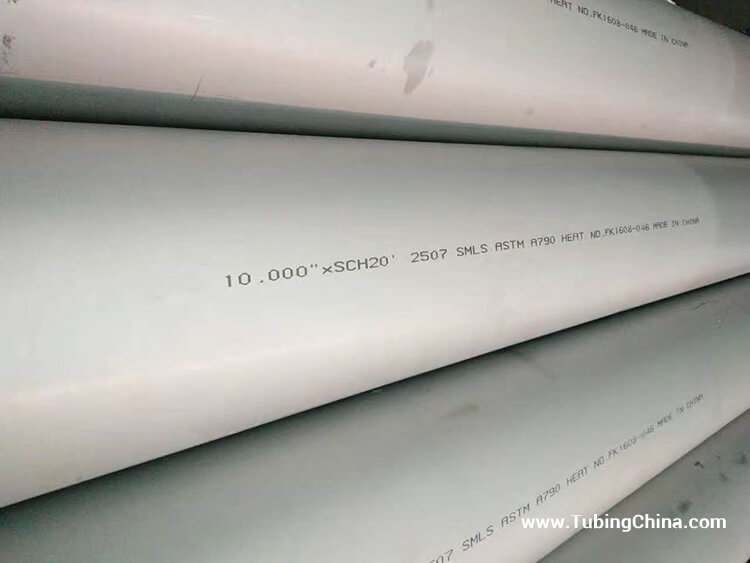
ASTM A789 / ASME SA789 covers grades of average wall thickness, or, if specified on the order, minimum wall thickness, of stainless steel tubing for services requiring general corrosion resistance, with particular emphasis on resistance to stress corrosion cracking. These steels are suscep- tible to embrittlement if used for prolonged periods at elevated temperatures.
The values stated in either SI units or inch-pound units are to be regarded separately as standard. The values stated in each system may not be exact equivalents; therefore, each system shall be used independently of the other. Combining values from the two systems may result in non-conformance with the standard. Within the text, the SI units are shown in brackets. The inch-pound units shall apply unless the M designation of this specification is specified in the order.
Referenced Documents
ASTM Standards:
A480/A480M Specification for General Requirements for Flat-Rolled Stainless and Heat-Resisting Steel Plate, Sheet, and Strip
A1016/A1016M Specification for General Requirements for Ferritic Alloy Steel, Austenitic Alloy Steel, and Stainless Steel Tubes
E527 Practice for Numbering Metals and Alloys in the Unified Numbering System (UNS)
SAE Standard:
SAE J 1086 Practice for Numbering Metals and Alloys (UNS)
2507 Tubes Ordering Information
Orders for product under this specification should in- clude the following, as required, to describe the desired material adequately:
Quantity (feet, metres, or number of lengths),
Name of product (seamless or welded tubes),
Grade
Size (outside diameter and average wall thickness, unless minimum wall thickness is specified),
Length (specific or random),
Optional requirements (for product analysis, see Section for hydrostatic or nondestructive electric test, see Section 10
Test report required (see the Inspection section of Specification A1016/A1016M
Specification designation, and
Special requirements.
General Requirements
Product furnished under this specification shall conform to the applicable requirements of specification A1016/ A1016M, unless otherwise provided herein.
Manufacture
The tubes shall be made by the seamless or welded process with no filler metal added.
Heat Treatment
All tubes shall be furnished in the heat-treated condition in accordance with the procedures shown in Table 2. For seamless tubes, as an alternate to final heat treatment in a continuous furnace or batch-type furnace, immediately follow- ing hot forming while the temperature of the tubes is not less than the specified minimum solution treatment temperature, tubes may be individually quenched in water or rapidly cooled by other means.
Product Analysis
1. An analysis of either one billet or one length of flat-rolled stock or one tube shall be made from each heat. The chemical composition thus determined shall conform to the requirements specified.
2. A product analysis tolerance (see the annex table on Chemical Requirements (Product Analysis Tolerances) in Specification A480/A480M) shall apply. The product analysis tolerance is not applicable to the carbon content for material with a specified maximum carbon of 0.04 % or less.
3. If the original test for product analysis fails, retests of two additional billets, lengths of flat-rolled stock, or tubes shall be made. Both retests for the elements in question shall meet the requirements of this specification; otherwise, all remaining material in the heat shall be rejected or, at the option of the producer, each billet or tube may be individually tested for acceptance. Billets, lengths of flat-rolled stock, or tubes that do not meet the requirements of this specification shall be re- jected.
NOTE 1—For flange and flaring requirements, the term lot applies to all tubes prior to cutting of the same nominal size and wall thickness that are produced from the same heat of steel. When final heat treatment is in a batch-type furnace, a lot shall include only those tubes of the same size and from the same heat that are heat treated in the same furnace charge. When the final heat treatment is in a continuous furnace, or when heat treated condition is obtained directly by quenching after hot forming, the number of tubes of the same size and from the same heat in a lot shall be determined from the size of the tubes as prescribed in Table 3.
NOTE 2—For tension and hardness test requirements, the term lot applies to all tubes prior to cutting, of the same nominal diameter and wall thickness that are produced from the same heat of steel. When final heat treatment is in a batch-type furnace, a lot shall include only those tubes of the same size and the same heat that are heat treated in the same furnace charge. When the final heat treatment is in a continuous furnace, or when heat treated condition is obtained directly by quenching after hot forming, a lot shall include all tubes of the same size and heat, heat treated in the same furnace at the same temperature, time at heat, and furnace speed, or all tubes of the same size and heat, hot formed and quenched in the same production run.
Mechanical Tests Required
1. Tension Tests—One tension test shall be made on a specimen for lots of not more than 50 tubes. Tension tests shall be made on specimens from two tubes for lots of more than 50 tubes (see Note 2).
2. Flaring Test (for Seamless Tubes)—One test shall be made on specimens from one end of one tube from each lot (see Note 1) of finished tubes. The minimum expansion of the inside diameter shall be 10 %.
3. Flange Test (for Welded Tubes)—One test shall be made on specimens from one end of one tube from each lot (see Note1) of finished tubes.
4. Hardness Test—Brinell hardness tests or Rockwell hardness tests shall be made on specimens from two tubes from each lot (see Note 2).
5. When more than one heat is involved, the tension, flaring, flanging, and hardness test requirements shall apply to each heat.
6. Reverse Flattening Test—For welded tubes, one reverse flattening test shall be made on a specimen from each 1500 ft [450 m] of finished tubing.
Hydrostatic or Nondestructive Electric Test
1 Each tube shall be subjected to the nondestructive electric test or the hydrostatic test. The type of test to be used shall be at the option of the manufacturer, unless otherwise specified in the purchase order.
2. The hydrostatic test shall be in accordance with Speci- fication A1016/A1016M, except that in the calculation of the hydrostatic test pressure 64000(441.2) shall be substituted for 32000(220.6).
Table.2 Heat Treatment
| UNS Designation | Temperature | Quenching |
| S31803 | 1870-2010 °F [1020-1100°C] | Rapid cooling in air or water |
| S32205 | 1870-2010 °F [1020-1100°C] | Rapid cooling in air or water |
| S31500 | 1800-1900 °F [980-1040°C] | Rapid cooling in air or water |
| S32550 | 1900 °F [1040°C] min. | Rapid cooling in air or water |
| S31200 | 1920-2010 °F [1050-1100°C] | Rapid cooling in water |
| S31260 | 1870-2010 °F [1020-1100°C] | Rapid cooling in water |
| S32001 | 1800-1950 °F [982-1066°C] | Rapid cooling in air or water |
| S32003 | 1850-2050 °F [1010-1120°C] | Rapid cooling in air or water |
| S32101 | 1870 °F min | Quenched in water or Rapidly cooling in other means |
| S32202 | 1870-1975 °F [1020-1080°C] | Rapid cooling in air or water |
| S32506 | 1870-2050 °F [1020-1120°C] | Rapid cooling in air or water |
| S32304 | 1700-1920 °F [925-1050°C] | Rapid cooling in air or water |
| S32750 | 1880-2060 °F [1025-1125°C] | Rapid cooling in air or water |
| S32760 | 2010-2085 °F [1100-1140°C] | Rapid cooling in air or water |
| S32950 | 1820-1880 °F [990-1025°C] | Rapid cooling in water |
| S32520 | 1975-2050 °F [1080-1120°C] | Rapid cooling in air or water |
Permissible Variations in Dimensions
1 Variations in outside diameter, wall thickness, and length from those specified shall not exceed the amounts prescribed in Table 5.
2 The permissible variations in outside diameter given in Table 5 are not sufficient to provide for ovality in thin-walled tubes, as defined in the table. In such tubes, the maximum and minimum diameters at any cross section shall deviate from the nominal diameter by no more than twice the permissible variation in outside diameter given in Table 5; however, the mean diameter at that cross section must still be within the given permissible variation.
Surface Condition
All tubes shall be free of excessive mill scale, suitable for inspection. A slight amount of oxidation will not be considered as scale. Any special finish requirements shall be subject to agreement between the manufacturer and the purchaser.
Product Marking
In addition to the marking prescribed in Specification A1016/A1016M, the marking shall indicate whether the tubing is seamless or welded and the wall designation (average wall or minimum wall).
2507 Tubes Export Record
Export ASTM A789 S32750 Stainless Steel Seamless Tubes finished in Pickling Annealing. Size with Outside Diameter in 38.1mm, Wall Thickness in 1.65mm Length in 8000mm. Total in 3000KGS.
2507 Super Duplex Pipe Export Countries
| MIDDLE EAST Saudi Arabia Iran Iraq UAE Qatar Bahrain Oman Kuwait Turkey Yemen Syria Jordan Cyprus | AFRICA Nigeria Algeria Angola South Africa Libya Egypt Sudan Equatorial Guinea The Republic Of Congo Gabon NORTH AMERICA USA Canada Mexico Panama Costa Rica Puerto Rica Trinidad And Tobago Jamaica Bahamas Denmark | EUROPE Russia Norway Germany France Italy UK Spain Ukraine Netherland Belgium Greece Czech Republic Portugal Hungary Albania Austria Switzerland Slovakia Finland Ireland Croatia Slovenia Malta | ASIA India Singapore Malaysia Indonesia Thailand Vietnam South Korea Japan Sri Lanka Maldives Bangladesh Mayanmar Taiwan Cambodia SOUTH AMERICA Argentina Bolivia Brazil Chile Venezuela Colombia Ecuador Guyana Paraguay Uruguay |
2507 Super Duplex Tube Related Links
ASTM A789 ASME SA 789 S31803 S32205 S32101 S32750 S32760 S32304 S31500 S31260 Seamless Tubes
ASTM A790 ASME SA790 S31803 S32205 S32101 S32750 S32760 S32304 S31500 S31260 Seamless Pipe
EN 10216-5 1.4462 1.4362 1.4162 1.4410 1.4501 Seamless Tubes